

I had a very interested but stale contact I wanted to reenergize. We had met at a conference, he had asked good questions, and then the thread went quiet for most of a year, which was my fault as much as his. The normal move would be to have an AI write me a follow-up email, and I think we all know what those read like, because we get forty of them a week.
Instead I found his name in my CRM and clicked "Sales Outreach." About a minute later, it had built this Flow:
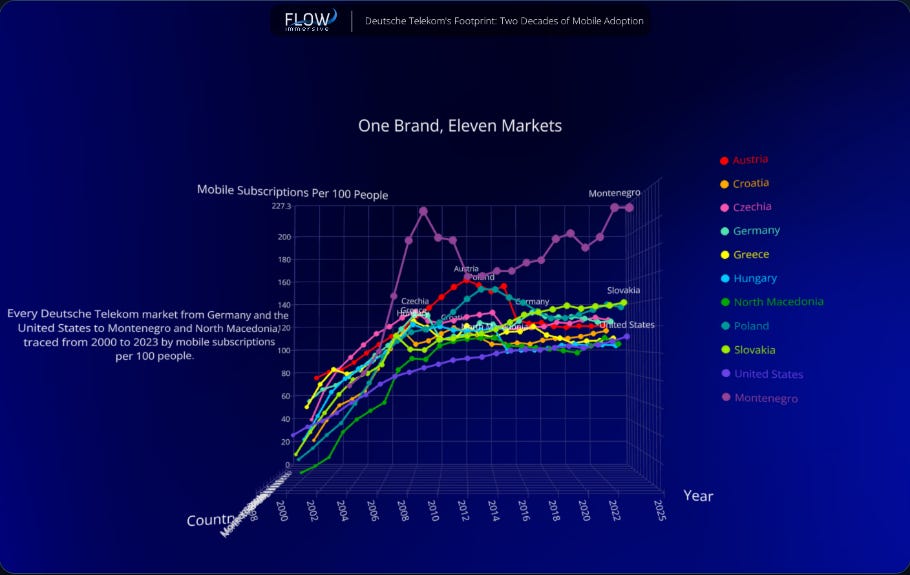
Try it yourself: https://a.flow.gl/flow/u78d5g4
It is not a profound visualization, and its value came from being hyper-specific to his market and his interests. I didn't upload a spreadsheet. It read what his business actually is, worked out which public sources would say something true about it, and went and got them. It retrieved 260 rows live from the World Bank while it composed, covering every one of the eleven markets his group operates in, 2000 to 2023. Nothing synthesized, nothing interpolated, every dot a real published figure you can click. Montenegro turns out to run above 200 mobile subscriptions per hundred people, which I did not know and neither did he.
Then it composed that into a story he moves through, with his own customers as the audience rather than me. He can open it on a laptop browser, on his phone, or on a pair of XREAL glasses.
The email I sent was two sentences and a link. He booked a meeting right away.
Five steps, and none of them are mine
The Flow was the part he saw. The part I want to show you is how it was made, because that is the actual news. This was built with the Flow Room, the private knowledge server we have been quietly building, which now runs for three organizations, including ours.
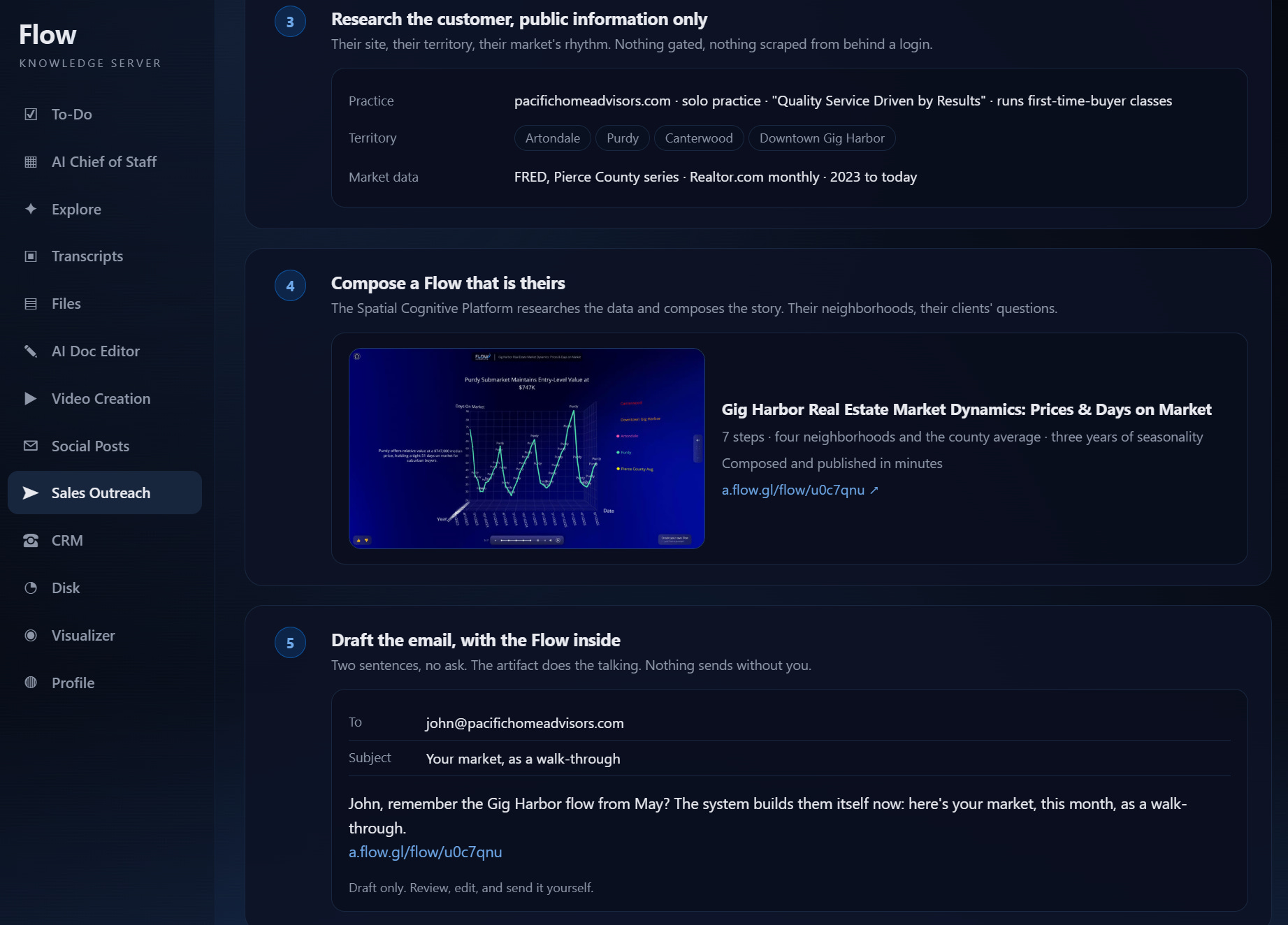
Here is the entire Sales Outreach process on one screen. I typed a name and clicked "Run outreach." I am sharing this run with the prospect's permission.
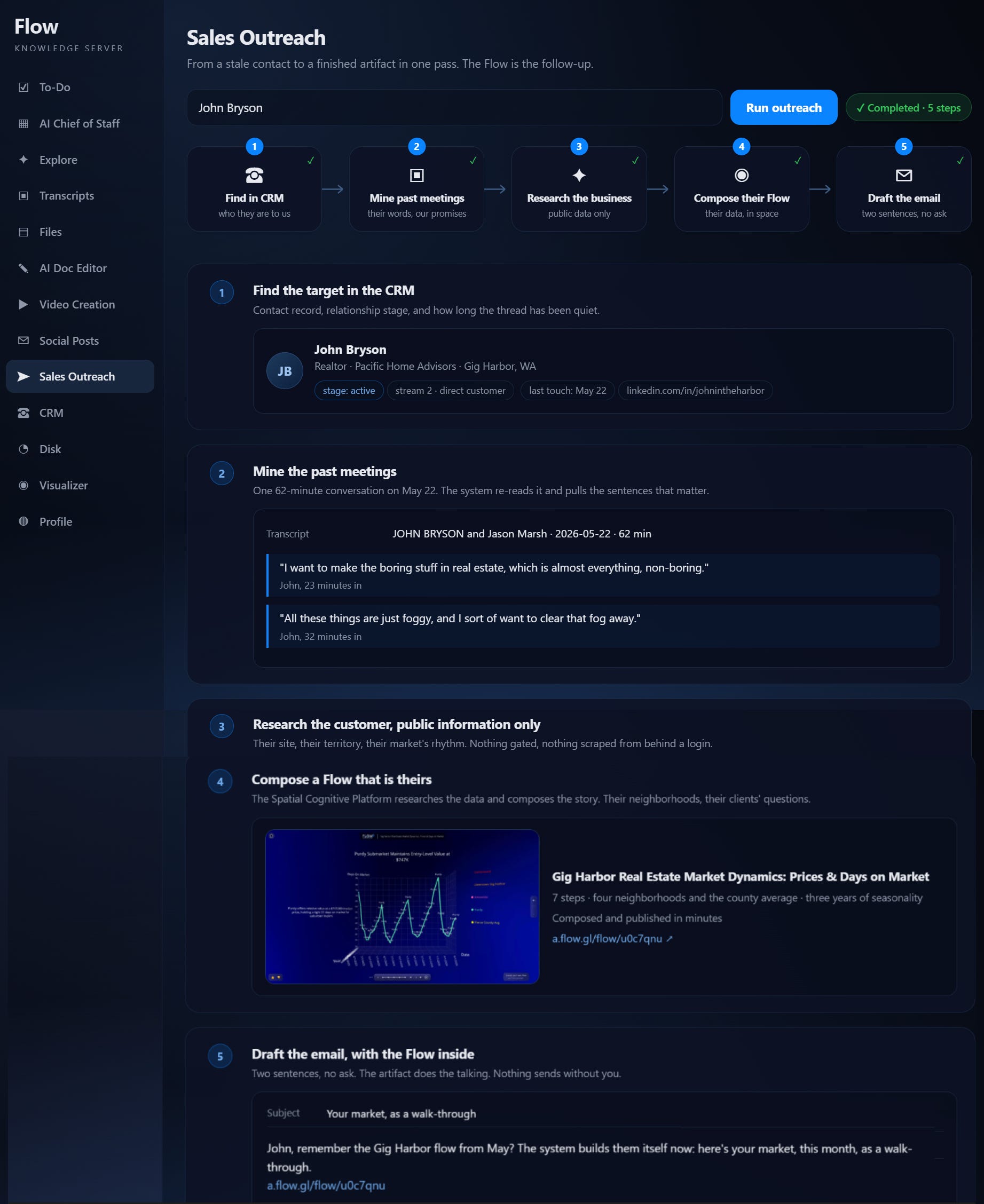
1. Find them in the CRM. Who they are to us: title, company, where we met, which stage the relationship is at, and how long the thread has been quiet.
2. Mine the past meetings. It re-reads every transcript we have with the person and pulls the two or three sentences that carry what they actually want, in their words rather than mine, along with any promise we left hanging. An unfulfilled "I'll follow up on that" is the opening, and the artifact becomes the follow-up.
3. Research the business. Public sources only: their site, their territory, their market's rhythm. Nothing gated, nothing scraped from behind a login.
4. Compose a Flow that is theirs. It picks the data sources, retrieves the rows, checks them, and composes a short spatial data story whose audience is their customers. For a realtor that was four neighborhoods against the county average across three years of seasonality. For the carrier it was two decades of mobile adoption across eleven countries.
5. Draft the email, with the Flow inside. Two sentences, no ask, because the artifact does the talking. It drafts and it never sends, so that part is still mine, and I do rewrite it.
Research and composition used to cost a day, which is why almost nobody built something custom for a single prospect. Now it costs a click and a minute, and that changes who you can afford to build for, and how often.
Why they remember it
Flow has had a unique perspective about experience creation since the beginning, and it is brain science rather than taste. The hippocampus files spatial experience and narrative in the same structures, which is why you can remember a room from a single visit, but cannot recall a single chart from last week. A recap has no location, so there is nowhere in the brain to put it. Give a finding a place, and a path to the next finding, and it stays. And the mental model is rich and detailed, so the person on the other end can make better decisions.
Where the Room gets all this from
Your company already produces its most valuable information every day: your meetings, your documents, your notes, your calls with customers. Today almost all of it evaporates.
The Room captures it into a private knowledge graph that belongs to you, on dedicated infrastructure, getting smarter about your business every week. It can also hold a mirrored copy of your internal databases, such as customer journeys and conversions, so the numbers in a story are the real ones. It is building a model of your business: who the people are, what was said, what the numbers actually are, what was promised to whom.
And then it makes things from that model. Outreach built from a prospect's own world, like the Flow above. A week of social posts in your voice, queued for you to approve. To-dos proposed from Tuesday's meeting. A CRM that fills itself in from your meetings. Your videos cut quickly. And uniquely, your data as spatial stories you can stand around with your team.
It keeps your words
We assume that you have a vision and don't want AI slop, so the Room optimizes for your exact words as much as possible. The LinkedIn post about this process, the deck that went with it, the newsletter this article grew out of, and this article itself were all composed by the Room from my dictation and my edits. I read every word and I changed the ones I wanted to change, and there were plenty of them. I even know the percentage of my exact words. The Room knows my business intimately and builds from the standpoint of human experience creation, instead of generating 40-page research reports or verbose slide decks.
If you run a small organization and you recognize the problem of the founder being the marketing department, the sales team and the analyst at the same time, then the Room is for you. We are taking on a small number of these, starting with a short pilot that ends with your own knowledge graph live and your first artifacts shipped. Get it touch if you’d like to join in.
And a question I keep turning over: what would you send someone if the experience were the easy part?