

If you run a small business, you are the marketing department, the sales team and the analyst. And if you have taken AI seriously this year, you probably have twenty tabs open, three AI chats going, a CRM you stopped updating in the spring, and a quiet feeling that you could be doing better with all of it.
I know that feeling. I found myself having dozens of AI command line windows working simultaneously. I built a system to manage them, and I was still creating dozens of tabs. The AI conversations were their own problem, because it seems like they can go on forever with massive scrolling sessions. And I was having a really hard time finding where they're at 10 minutes or 10 hours later.
So I had the AI measure it. Across four months of my own logs, about 7% of my time went to finding things, which is five minutes of every hour. But I doubt I am the only one losing those forty minutes a day, as well as my train of thought.
A Room, because your brain remembers spatially
For about ten years I have built 3D data stories at Flow Immersive, data floating over the table so a group can stand around it and point. The reason was always brain science. The hippocampus files spatial experience differently than a bar graph, which is why you can remember a room from a single visit but cannot recall a single PowerPoint slide from last week.
I turned that idea on my own workday. If what we say about spatial cognition is true, how do I build the whole interface so it is consistent with those principles? The answer is the Flow Room, one room for your whole workday. Your whole workday lives in this tool, along the meetings that you have.
The Room learns how your business actually runs from what you already produce: your meetings and call transcripts, your dictation (a lot of mine happens in the car), and your email. From that it keeps a private knowledge graph of who the people are, what was said, what the numbers are, and what was promised to whom.
And then it makes things, such as outreach, newsletters, posts, to-dos, data stories and even working apps. What I care about most is that it makes things that ARE you, not things that SOUND LIKE you. It interviews me to create my substack, and then it uses my words instead of rewriting it into AI slop.
How it works
First, the Room ingests a directory of documents such as a Google Drive and learns everything about you and the organization. It can connect to your gmail, and other services you use to communicate.
The Room interface is set up like a newsroom, with seven desks: Front desk, People, Knowledge, Strategy, Content, To-do and Build. Each desk shows what is on it, and each one has a conversation with the AI at your side.
Instead of having just a long scrolling window that goes on forever, each turn as you enter some text and respond to it, it has its own card. The whole point of this is you can get back to tasks really quickly.
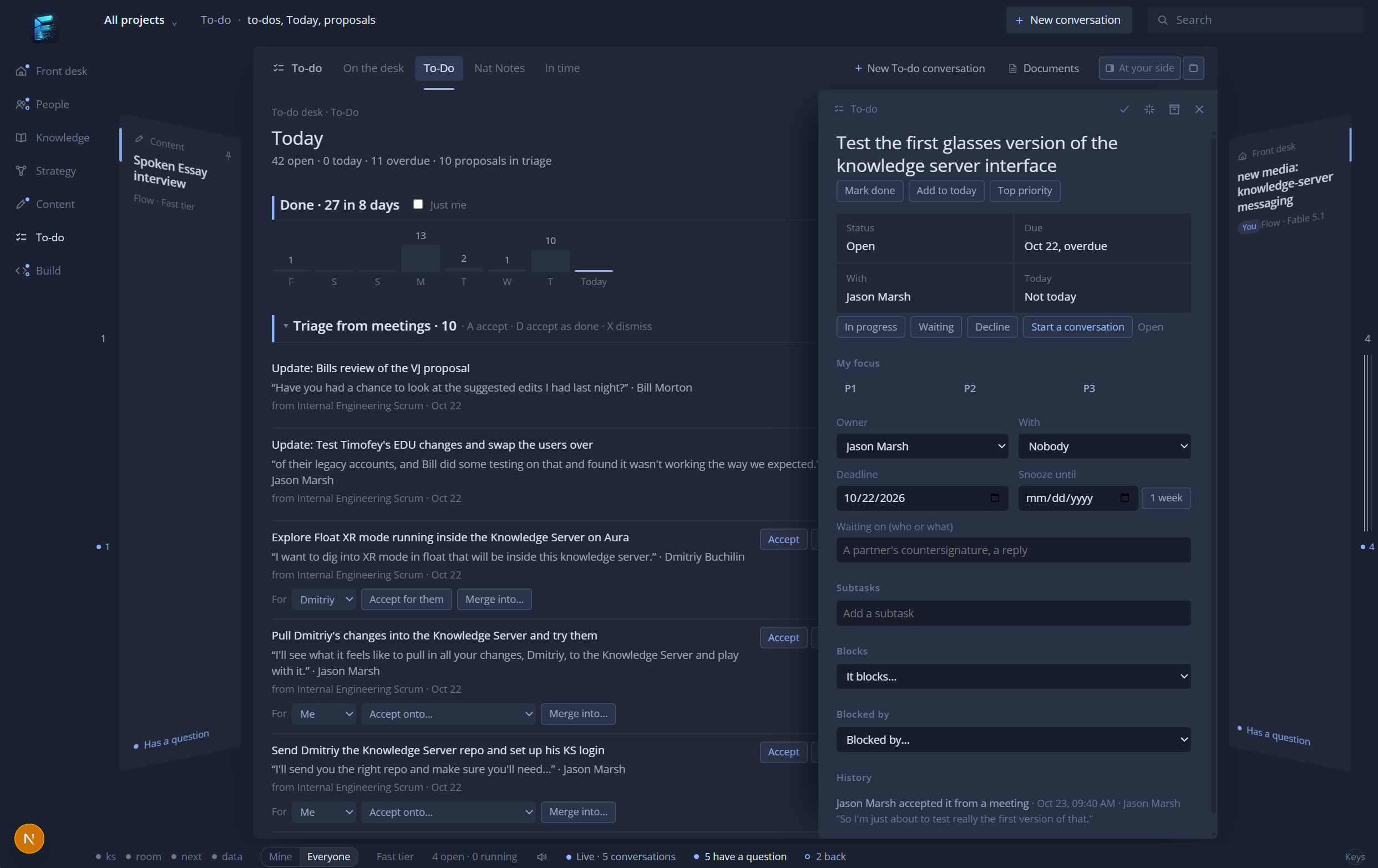
The cards you are working with sit to your left and right on the table, two or three on either side on a big monitor, and you slide along them. Very often I'm working on two or three things and being able to keep them in mind and get back and forth between them here is just really nice. I'm really playing on the fact that I understand how spatial brains work.
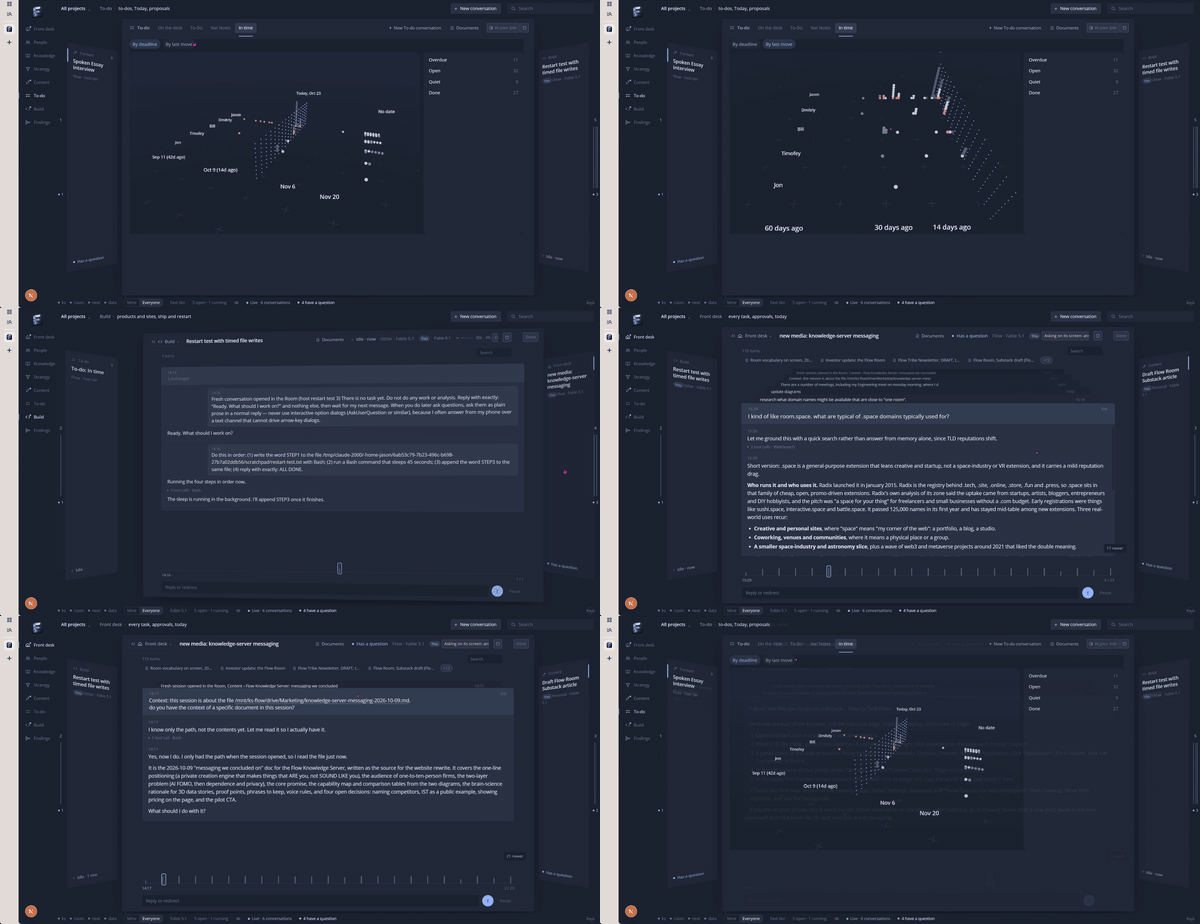
Open any record, whether a contact, a meeting or a draft, and it comes up in the Detail panel, linked back to the Gmail draft or Drive file it came from. Type into a document the Room made and hand it back, and it goes and sees what changed and carries on from there. You approve every piece before it goes out.
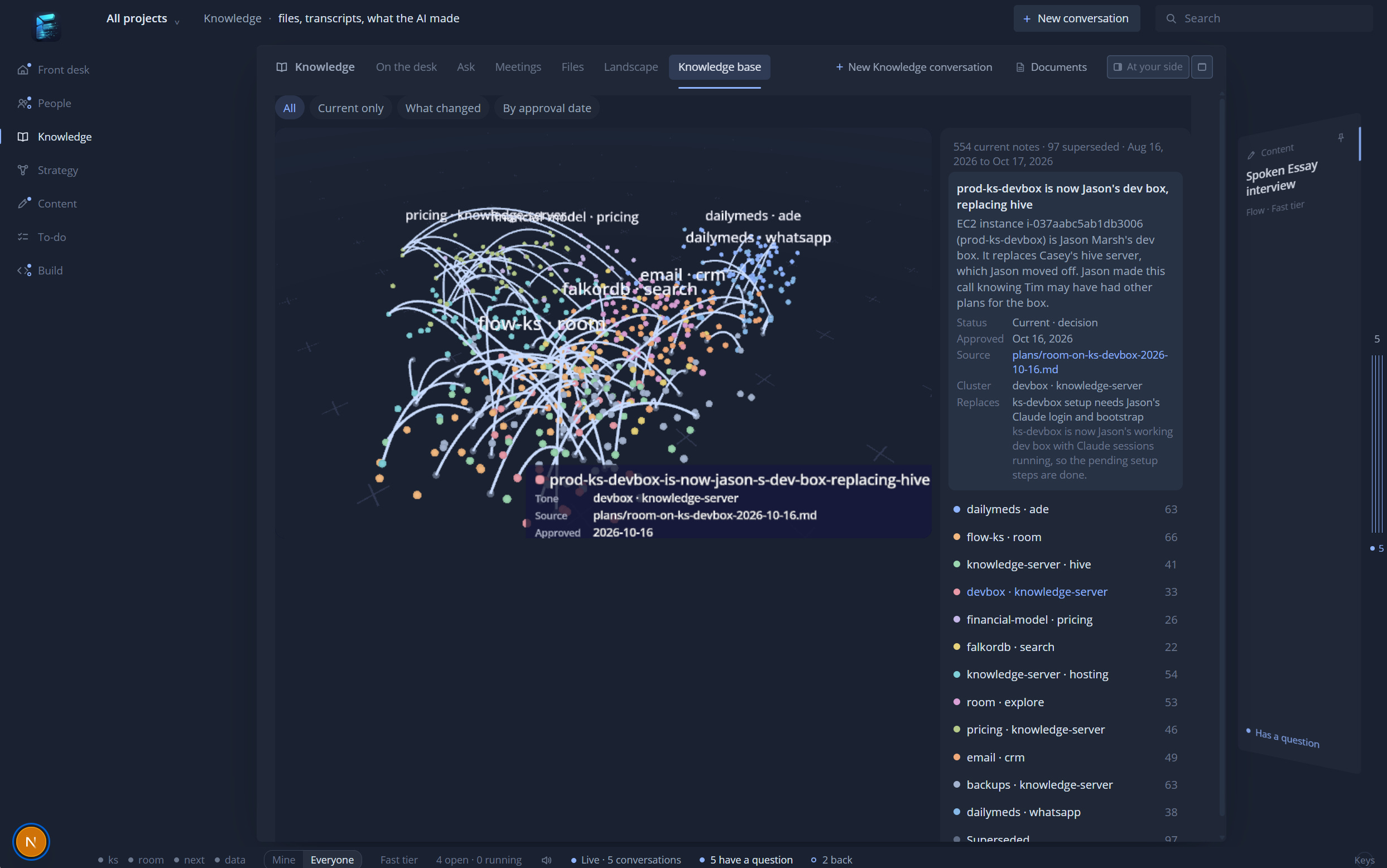
Some of this sounds ordinary on its own: a CRM that fills itself in and tells you who is due, a second spam filter based on active learning to identify the AI slop that gets past Google, to-dos pulled from Tuesday's meeting and automatically marked as done when you say so in Thursday's meeting. On first glance, it's like, oh, yeah, you could do this in other tools, this is not unique to us. The difference is having your whole universe in one room, tuned to your voice and to your spatial brain.
The 3D is part of it too, in what I call Data Flows: your contacts clustered by company and stage, your to-dos on a time axis, a strategy question with each hypothesis scored against the evidence. The 3D visualizations are just part of the whole thing. And when you need to explain something to a customer, the Room builds a Flow, a 3D data story they can walk through, link for a laptop browser or phone.
Here is the moment that sold me on my own product. On a call, Natalie from The Daily Meds described a QR-code app she wanted for a music conference. Afterwards in the Flow Room, I clicked New Conversation (no need to find anything) and told it to look at the meeting I just had with Natalie, and build the app we talked about. That was all I said. In one shot, it built the Android app, and it worked. I did need to make sure I described the functionality reasonably well in that meeting, but then I didn’t have to think about it again, and it was completed with instructions for Natalie to download and install.
The Room works on a phone too, where a swipe moves you between your conversations and artifacts. I actually really do like being able to use and accomplish everything just on my phone. Next, the same Room goes onto glasses such as the XREAL Aura, laid out in the space around you. It is part of my strategy to just have this whole web interface be on our Android XR. If the glasses take off, we will be sitting at the heart of that and be ready.
Your own server, under your own lock and key
Every Room runs on its own server, private to you, or on your own box in your own building. It does not care which AI model sits underneath, so you can swap models as they improve or run your own.
A school we work with in China showed me why that matters. Its technology lead watched an American nonprofit with schools in China get a notice from its AI provider that the whole organization was cut off, starting immediately, with no chance to download its data, because China IPs are outside of the terms of use. The whims of changing government policies shouldn’t have to affect you. With a Flow Room, your data stays yours and nobody can close your account on you.
Today the Room runs for Flow and our first 2 customers. We and our first customers are literally spending eight to 10 hours a day in the app. I am taking on a small number of founders and small firms, each Room built around how you actually work, with generous customization for you. It is for founders who have a clue, have a vision, and want to represent themselves as a real person in the world.
If that sounds like you, I would like to show you. Ping me to set up a time. I have convictions that are lightly held, so tell me what you would want in your Room.